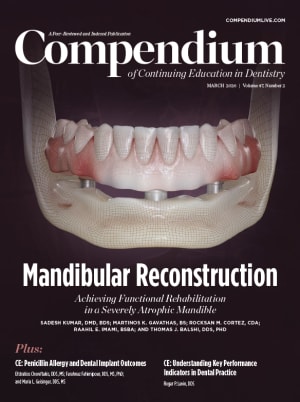
Abstract: Mandibular staple implants were historically used to manage mandibular fractures and retain overdentures but are associated with long-term complications. This case report describes an 85-year-old patient with chronic infection and bone loss related to a decades-old mandibular staple implant. Digital planning facilitated safe implant removal, grafting, and reconstruction using narrow-diameter endosseous implants. The article highlights surgical challenges, risk mitigation, and successful functional rehabilitation in a severely atrophic mandible.
Mandibular staple implant systems were developed in Michigan from 1963 to 1964.1 Mandibular staple implants were intended as an effective surgical solution for the management of mandibular fractures, mandibular repositioning, and temporomandibular joint (TMJ) disorders. The implant was engineered using the orthopedic bone plating designs of Wiles plates,2 metal plates screwed onto bone to hold the fractured segments rigidly in place. At that time, the mandibular staple implant system was a significant improvement over subperiosteal and blade implants for dental rehabilitation of the edentulous mandible. This implant solution, which involves affixing a metal plate to the jaw’s inferior border with posts that extend through the bone into the mouth to support a denture, is designed with a large contact surface with a bicortical screw utilizing the osseointegration principle.3
Considered for use in cases of severe bone atrophy, placement of a mandibular staple implant is a more complex and sensitive technique than that of conventional root-form endosseous implants. Complications associated with staple implants include soft-tissue infections, peri-implantitis, implant mobility, and prosthetic component issues.4 Some patients may require some form of surgical intervention during the lifespan of this implant system. This case report discusses the surgical removal of a staple implant and the digital planning and mandibular reconstruction with narrow-diameter implants.
Case Report
An 85-year-old woman presented to the authors’ dental office complaining of pain and swelling of the anterior mandible, which had been occurring for the past 2 years. A staple implant had been placed sometime in the 1980s for the retention of a mandibular overdenture. The patient started developing recurrent soft-tissue infection associated with the implant (Figure 1).
The patient’s history revealed that the infections typically would occur every month and be resolved with a course of oral antibiotics. Her medical history consisted of hypertension and prior stroke, atrial fibrillation, hyperlipidemia, and placement of a cardiac pacemaker. Her medications included Caltrate® 600 D, aspirin 81 mg, carvedilol 6.25 mg, lisinopril 2.1 mg, and warfarin 2 mg.
Her surgical history did not indicate any complications from previous surgery or anesthesia. Upon initial clinical examination, there was no cervical or facial edema and no lymphadenopathy. The patient had a good mandibular range of motion. Facial soft-tissue support was adequate while wearing the mandibular denture. The denture showed good retention, with approximately 1.5 mm of the two terminal implant posts exposed with gingival recession and gingivitis. Bleeding on probing was noted with both transmucosal components. The mandible was atrophic with minimal vestibule.
A cone-beam computed tomography (CBCT) scan showed a severely resorbed mandible with infection and resorption on the right side of the implant posts, which indicated pathological fracture or bone missing on the labial side. Three other screw components that were part of the staple implant system were stabilizing the implant in the mandibular symphysis (Figure 2).
Treatment options were discussed with the patient. She preferred an immediate solution with endosseous implants with a fixed removable prosthesis. The primary goals of the treatment were to eliminate infection, decrease the pathologic fracture, and place implants on the remaining available bone to facilitate a fixed prosthetic solution. The treatment options discussed also included complete and partial removal of the mandibular staple implant. Because of the perceived high risk for mandibular fracture, the reconstruction plate was customized for the mandible and a virtual surgical plan for plating and a guide were fabricated (Figure 3). It took 6 weeks to receive medical clearance and for virtual surgical planning and plate manufacturing. Then the patient developed an acute skin infection in the neck a few days before the surgery (Figure 4).
A series of preoperative CBCT scans of the staple implant before removal demonstrated the extensive mandibular bone loss (Figure 5).
Procedure Details
Under nasoendotracheal intubation, the neck was disinfected and draped. A submental incision was used to expose the mandibular staple implant at the inferior border. A subperiosteal dissection was performed, exposing the inferior border plate and the mental nerves bilaterally (Figure 6 and Figure 7).
During dissection, purulence was noted in the lower border of the mandible. The two implant posts, which held the denture intraorally, were completely exposed. There was no fracture or discontinuity in the mandible. An attempt was made to remove the staple implant at the inferior border with elevators, however removal was not possible. The intrabony posts of the implant were osseointegrated. A 702L bur was used to disengage one of the terminal posts and the base plate. The base plate and post were removed separately. The granulation tissue was curetted for culture and sensitivity testing. The tissue specimen taken was sent to pathology. The other implant post was found to be still well integrated after disengaging the base plate, despite the chronic infection. Trephines were used to remove the other post (Figure 8 and Figure 9). The base plate was sectioned from the three smaller screws, which were left in situ, as removing them would have compromised the remaining bone structure.
Once the implant posts were removed, the infected site was debrided with the bur until healthy bone marrow was encountered. Once debridement was complete, the intraoral mucosa was approximated with vicryl 4.0 sutures. Water-tight mucosa was confirmed. The neck site was irrigated with saline to remove titanium particles and infected materials.
Corticocancellous allografts were mixed with platelet-rich plasma and packed in the crestal/bony defect site to create space for future implants and covered with resorbable membranes. The method used was the tissue engineering triangle concept (Figure 10 and Figure 11).5
The submental wound was approximated in two layers. Preoperative antibiotic Ancef 2 gm was given to the patient. Postoperatively, the patient was prescribed amoxicillin 250 mg and metronidazole 250 mg three times a week.
Pain was managed with over-the-counter ibuprofen as needed. The patient’s postoperative condition and healing were uneventful. There was no intraoral evidence of dehiscence or infection. Immediate postoperative CBCT scans showed the three screws from the original staple implant left in situ.
The patient was made aware of and accepted additional reconstructive procedures offered, which included increasing the attached gingiva with free gingival graft or alloderm at the mandibular crest and placing an endosseous implant for the prosthetic solution.
After the grafts had 7 months to heal, implants were placed in the mandible in positions Nos. 21, 23, 26, and 28. The flap was dissected and displayed growth. However, the amount of available bone was minimal. Each implant was 10 mm in length; the two anterior implants were narrow in diameter at 3.3 mm. A torque of 50 Ncm was achieved in the healthy, previously grafted bone. Implants were placed avoiding the areas of lost bone. To promote more bone growth, another graft was performed.
A cancellous mix and xenograft were used adjacent to the four implants placed. A platelet-rich fibrin (PRF) membrane was placed atop the area of the bone graft. Vicryl 4.0 gut suture was used to close the flap (Figure 12 through Figure 15).
Based on CBCT imaging (Figure 16), the implant reconstruction was successfully implemented. The implants had strong, albeit minimal, bone, allowing for good torque. However, due to the pre-existing pin and reduced bone-to-implant contact, the implant on tooth No. 26 failed to integrate and was, therefore, removed. Because a denture was providing maxillary occlusion, it was decided that three implants would be sufficiently stable with the use of a titanium bar. Also, the patient did not want to undergo additional surgery. Upon completion of the graft, implant placement, and implant removal of the failed No. 26 implant, a review of the gum tissue illustrated successful results (Figure 17 and Figure 18).
Postoperative and final images are shown in Figure 19 through Figure 25.
Discussion
The treatment of edentulous patients can include the use of complete dentures, implant overdentures, and implant fixed prostheses. Edentulism in the mandible is a more challenging issue compared to the maxilla. The cumulative success of staple implant systems is 90.89% over 8 to 16 years of function,6 providing good function and minimal major complications. Mobility has been a chief concern with staple implant systems. The soft tissue around the staple pin contributes to most of the complications.7 The overall success rate of mandibular staple implants has been shown to be comparable to endosseous implants.8
In the present case, the patient experienced the benefits of her mandibular staple implant–supported overdenture for more than 40 years. Mandibular staple implants offer a valuable alternative to traditional fixation methods in the management of mandibular fractures. The cited advantage of using allografts compared to iliac grafts lessens the issues associated with the need for donor sites and can reduce length of stays in the hospital.9
Replacement of the existing mandibular staple implant system in this case was necessary due to chronic, recurrent infection and progressive bone loss that compromised the implant’s stability and the integrity of the mandible. The patient experienced persistent soft-tissue infections requiring antibiotics, peri-implant inflammation, gingival recession, and implant post exposure. Imaging revealed severe mandibular atrophy, active infection, bone resorption around the implant posts, and loss of stabilization screws, creating a risk of pathologic fracture. These complications made continued retention of the staple implant unsafe and necessitated removal and reconstruction.
Conclusion
This case report underscores the significance of individualized treatment planning, meticulous surgical technique, and close postoperative follow-up in achieving successful outcomes when managing complex cases involving mandibular staple implants. While challenges and complications may arise, proper planning and adaptation of surgical approaches can lead to improved patient comfort, function, and esthetics. Further research and advancements in this field will further enhance dentistry’s understanding and utilization of mandibular staple implants as a valuable tool in oral and maxillofacial surgery.
ABOUT THE AUTHORS
Sadesh Kumar, DMD, BDS
Private Practice, Melbourne, Florida; Membership of the Faculty of Dental Surgery, Royal College of Surgeons of England (MFDS RCS); Diplomate, International Congress of Oral Implantologists
Martinos K. Gavathas,
BS Dental Assistant, Melbourne, Florida
Rocksan M. Cortez,
CDA Dental Assistant, Melbourne, Florida
Raahil E. Imami,
BSBA Dental Assistant, Melbourne, Florida
Thomas J. Balshi, DDS, PhD
Prosthodontist Emeritus, Founder, Pi Dental Center, Fort Washington, Pennsylvania; Diplomate, American Board of Prosthodontics; Fellow, American College of Prosthodontists
References
1. Small IA. Chalmers J. Lyons memorial lecture: metal implants and the mandibular staple bone plate. J Oral Surg. 1975;33(8):571-585.
2. Williams DF, Roaf R, Maisels DO. Implants in Surgery. Philadelphia, PA: WB Saunders; 1973:28.
3. Current evaluation of dental implants. Council on Dental Materials and Devices. J Am Dent Assoc. 1972;84(6):1358-1372.
4. Small IA, Kobernick SD. Implantation of threaded stainless steel pins in the dog mandible. J Oral Surg. 1969;27(2):99-109.
5. Marx RE. Platelet-rich plasma: evidence to support its use. J Oral Maxillofac Surg. 2004;62(4):489-496.
6. Small IA. The fixed mandibular implant: a 6-year review. J Oral Maxillofac Surg. 1993;51(11):1206-1210.
7. Small IA, Misiek D. A sixteen-year evaluation of the mandibular staple bone plate. J Oral Maxillofac Surg. 1986;44(1):60-66.
8. Kent JN, Misiek DJ, Silverman H, Rotskoff K. A multicenter retrospective review of the mandibular staple bone plate. J Oral Maxillofac Surg. 1984;42(7):421-428.
9. Pogrel MA. The lower border rib for mandibular atrophy. J Oral Maxillofac Surg. 1988;46(2):95-99
Figures and Images

Figure 1

Figure 2

Figure 3

Figure 4

Figure 5

Figure 6

Figure 7

Figure 8

Figure 9

Figure 10

Figure 11

Figure 12

Figure 13

Figure 14

Figure 15

Figure 16

Figure 17

Figure 18

Figure 19

Figure 20

Figure 21

Figure 22

Figure 23

Figure 24

Figure 25